The locking mechanism on your flooring planks is the single most important structural detail you've probably never thought about.
When you buy LVP, laminate, or SPC flooring, the plank surface, wear layer, and color get all the attention. But underneath, the edge profile — the machined tongue-and-groove system that holds each plank to its neighbor — determines whether your floor stays tight for 20 years or starts gapping and peaking in 18 months.
There are two main families of click-lock systems: drop-lock (also called fold-down) and angle-lock (also called angle-angle or Uniclic-style). Drop-lock promises faster installation. Angle-lock is what professional installers actually prefer. Here's why.
What Is Drop-Lock Flooring?
Drop-lock systems connect the short edge of a plank by folding it downward. You angle the long edge in, line up the short end, and push down. A small plastic or fiberglass-reinforced tongue on the short edge compresses, then springs back into a groove on the adjacent plank, creating a lock. Välinge's 5G system and i4f's OneLock are the most widely licensed drop-lock technologies.
Manufacturers love drop-lock because it's fast — you can lay long, straight runs of flooring very quickly. The marketing sounds great: "just fold and click." For a DIYer installing a simple rectangular room, it genuinely is easier.
The problem: The short-edge lock relies on a thin plastic tongue that is the weakest structural point on the entire plank. If that tongue is slightly out of spec, gets damaged during installation, or becomes brittle over time, the joint fails. You get a gap, a lifted edge, or a peaking seam.
What Is Angle-Lock Flooring?
Angle-lock systems — the most well-known being Unilin's Uniclic, used by Quick-Step and other major brands — connect both the long and short edges by angling the plank into position. No separate plastic insert. No fold-down mechanism. The locking strength comes from the plank's core material itself, machined into a precise tongue-and-groove profile with built-in pre-tension that actively pulls planks together.
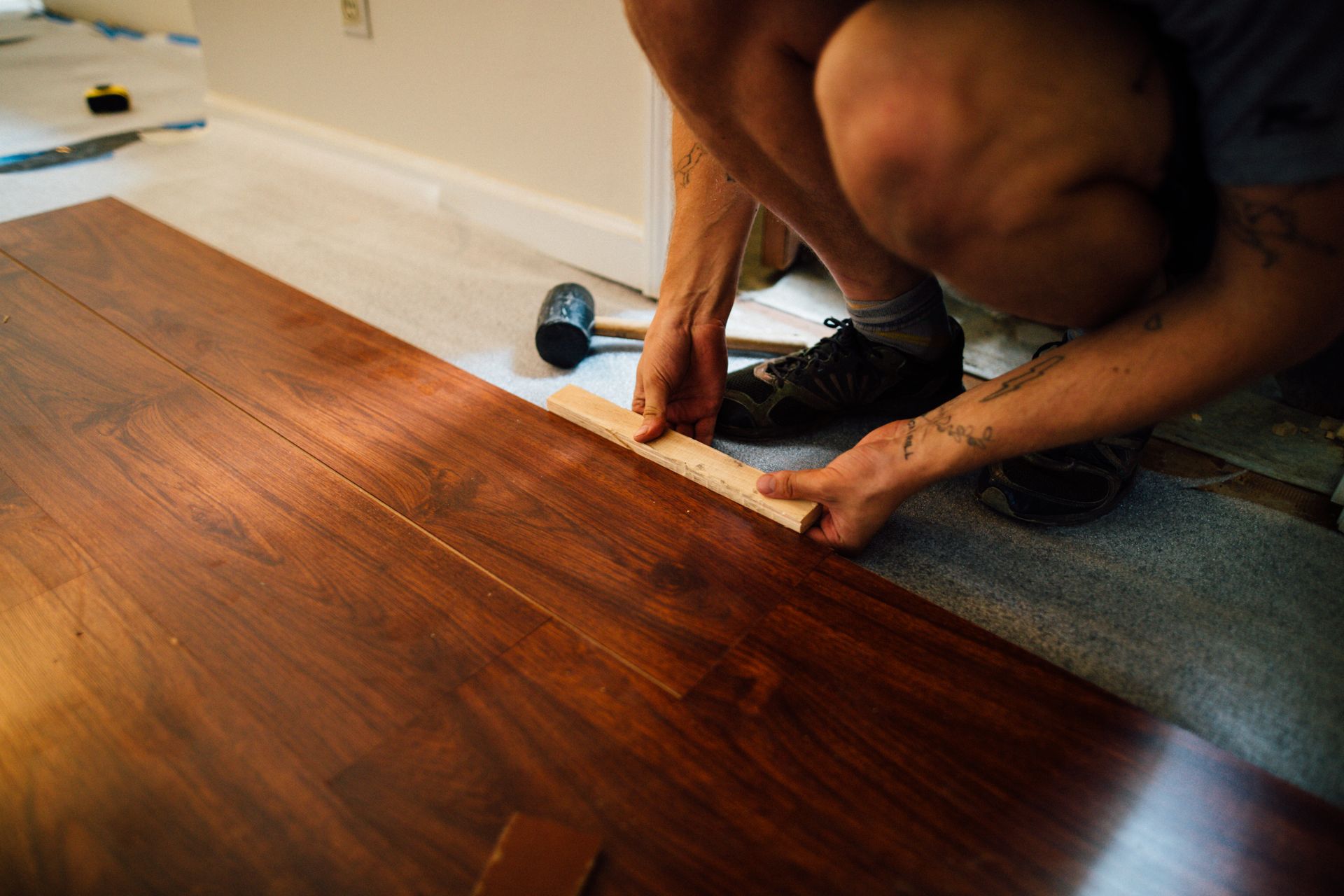
Angle-lock also supports a second installation method that drop-lock can't match: the tap-in. When you can't angle a plank into place — under a door jamb, in the last row against a wall, or around an obstacle — you can slide it in horizontally and tap it locked using a special tapping block. The profile design allows the short edges to slide and snap into place without lifting or dropping the plank.
This is the feature that professional installers care about most. In the real world, rooms aren't perfectly rectangular. There are doorways, cabinets, radiator pipes, stair transitions, and that one last row where you have half an inch of clearance. Drop-lock systems force installers to compromise in those situations — shaving the locking lip off the plank and gluing the joint, which weakens the floor. Angle-lock handles them cleanly.
Head-to-Head Comparison
| Factor | Drop-Lock | Angle-Lock |
|---|---|---|
| Installation speed | Faster in open runs | Slightly slower, more controlled |
| Short-edge strength | Weaker (plastic tongue or thin fold) | Stronger (full core material engaged) |
| Repairability | Hard to disassemble without damage | Can be angled up and out cleanly |
| Tight spaces (door jambs, last row) | Difficult — often requires shaving the lock | Tap-in method works without damaging lock |
| Long-term gap resistance | Higher risk of gapping over years | Pre-tension pulls planks tight permanently |
| Manufacturing tolerance sensitivity | High — cheap brands ship 5–15% out-of-spec | Lower — forgiving of minor deviations |
| Cost | Often cheaper (budget SPC/LVP) | Often slightly more expensive |
Why Professional Installers Prefer Angle-Lock
Talk to professional flooring installers — the people who lay 2,000 sq ft of LVP every week — and you'll hear the same themes:
🔧 Repairability
Angle-lock planks can be angled up and out for replacement without damaging the locking profile. Drop-lock planks often require breaking the plastic tongue to disassemble — meaning you may need to replace more planks than the damaged one.
📏 Manufacturing tolerance
Cheap drop-lock SPC from no-name suppliers can ship 5–15% of planks with damaged or out-of-spec short edges. Angle-lock is more forgiving of minor profile deviations because the lock engages more material.
🚪 Tight spaces
Door jambs, last rows, under cabinets — angle-lock's tap-in method handles these without compromise. Drop-lock installers often shave the locking lip and glue, which voids warranty and weakens the joint.
⏱ Long-term gap resistance
Uniclic's pre-tension design constantly pulls planks together, resisting seasonal expansion and contraction. Drop-lock's simpler short-edge connection is more prone to slight gapping over years of use.
The Honest Caveat
Drop-lock is not inherently bad. Välinge 5G and i4f systems are engineered to high standards and used by premium brands like Quick-Step, Pergo, and Mohawk. When manufactured correctly and installed on a flat subfloor, they perform well.
The problem is that drop-lock is less forgiving. It demands tighter manufacturing tolerances and more careful installation. When you buy budget SPC from a big-box store or an unknown Amazon brand, the drop-lock profile is where quality corners are cut first. The planks look identical on the shelf — but the edge profile tells a different story.
Angle-lock, by contrast, has a larger margin for error built into its design. That's why professionals trust it in situations where they can't control every variable — and in homes where the floor needs to last 15+ years without callbacks.
What to Ask Before You Buy
If you're buying flooring and want to know which locking system it uses, ask these questions:
What locking system does this product use? (Look for "Uniclic," "angle-angle," or "5G" on the spec sheet.)
Is the short edge a fold-down/drop-lock or an angle engagement?
What is the brand and country of origin? (Premium European brands tend to have tighter tolerances.)
Can the planks be tapped in horizontally for tight spaces, or do they only fold down?
What happens if I need to replace a damaged plank in five years?
Frequently Asked Questions
What is the difference between drop lock and angle lock flooring?
Drop-lock (also called fold-down) connects the short edge of a plank by folding it downward until a plastic tongue clicks into place. Angle-lock (also called angle-angle or Uniclic-style) connects both the long and short edges by angling the plank into position, engaging the core material itself for a tighter mechanical lock.
Why do professional installers prefer angle-lock systems?
Angle-lock systems are more durable, easier to repair, and more forgiving in tight spaces. The locking strength comes from the plank's core material, not a separate plastic insert that can break. Angle-lock also supports a tap-in method for door jambs and last-row planks, while drop-lock systems often require shaving or compromising the lock in those situations.
Is drop-lock flooring bad quality?
Not necessarily. Premium brands like Quick-Step and Pergo use licensed drop-lock technologies (Välinge 5G, i4f) that perform well when manufactured to tight tolerances. The problems arise with budget SPC and LVP products from no-name suppliers, where manufacturing tolerances are looser and the short-edge locking mechanism is more likely to fail or gap over time.
Can drop-lock flooring be repaired if a plank is damaged?
It is more difficult. Disassembling drop-lock planks without breaking the plastic tongue or damaging the fold-down profile requires care, and damaged locking edges cannot always be reassembled securely. Angle-lock planks can typically be angled up and out and reinstalled without damage.
Does the locking system affect the cost of my flooring project?
The locking system itself does not change installation labor cost, but it can affect long-term repair costs. If a drop-lock floor develops gaps or lifted seams years later, repairing individual planks is harder and may require replacing a larger section. Use the flooring cost calculator to estimate your project budget before choosing materials.
Next step
Budget your flooring project first.
Knowing the locking system helps you choose quality materials. Knowing the budget helps you choose a contractor you can trust.
Disclaimer: This guide is for informational purposes only. Locking system names and patents are owned by their respective companies (Välinge Innovation, Unilin Technologies, i4f). Product performance varies by brand, manufacturing quality, subfloor condition, and installation method.